Lorem ipsum dolor sit amet, consectetur adipiscing elit. Etiam id libero non erat fermentum varius eget at elit. Suspendisse vel mattis diam. Ut sed dui in lectus hendrerit interdum nec ac neque. Praesent a metus eget augue lacinia accumsan ullamcorper sit amet tellus. Duis cursus egestas hendrerit. Fusce luctus risus id elit malesuada ac sagittis magna tempus. Sed egestas fringilla turpis at ullamcorper. Pellentesque adipiscing ornare cursus.
A lack of access to pools and the money to pay for lessons drives a
racial divide in swimming ability. But after getting married, I had no
choice but to dive in
Swimming: why risk it?
Photograph: Maggie West for the Guardian
“If
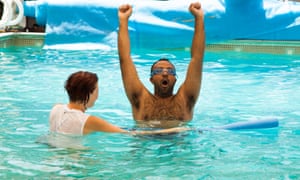
you just relax, you’ll float. Everyone floats,” Monica, the instructor,
says calmly while I’m flapping my extremities in sheer terror. I’m in
the deep end of a Los Angeles swimming pool in May, and I’m here to
learn how to swim. Swimming
is not something I do, nor am I particularly fond of being in the water
unless I’m in a bubble bath. Why? Drowning. Choking. Sinking to the
bottom. I just can’t figure out why anyone would willfully put
themselves in a situation where they could die so easily. Why risk it? I
also feel this way about skydiving, rock climbing, and unprotected
sexual relations with a stranger in a truck stop bathroom. But here I am
today, decidedly taking this step – or splash, if you will afford me
the rhetorical indulgence.
Throughout my life, curious folks have often asked about my aversion to swimming, and the conversation has inevitably turned to race.
My wife’s aunt came up to me at a family event and said that she heard
“black people’s skin was heavier, therefore they couldn’t float as
easily”. I’m not one to stir up trouble in a social situation. I hate
squabbles, especially when relatives are involved, and there’s no way to
win an argument like that. What was I supposed to do – weigh my own
skin to prove her wrong? All I could do was shrug my shoulders and say,
“Maybe.”
Pinterest
At the pool. Photograph: Maggie West for the Guardian
In truth, black people not swimming is something of a public health problem. A study
by the US Centers for Disease Control and Prevention found that 10
people die every day from drowning. Black and Hispanic youths are far
more likely to drown than white kids. Seventy percent of black children
cannot swim, while only 42% of white children reported a lack of
swimming ability.
The reason for this has nothing to do with physical differences and
everything to do with lack of access. In America, swimming is not a
skill we’re required to learn. It’s a privilege afforded to the
fortunate souls who live near a pool or accessible natural body of
water, and who can afford to pay for lessons. This excludes inner city
African Americans who lack one or both of those opportunities.
I was fortunate to live in a small town in rural central California,
in a middle-class military family that could afford swimming lessons.
Still, I was about as unconventional as one could be in a very
conservative part of the state. My Caucasian father was in the air force
and my African American mother stayed at home to take care of the kids.
In an effort to get me out of the house and away from the Star Trek
reruns that consumed most of my time, she tried to expose me to all
manner of extracurricular activities: tap dancing, racquetball,
jazzercise, and, eventually, swimming. I rejected every single hobby,
but especially swimming. I didn’t see the point. I didn’t like the
water, and as a result I was a dodgy swimmer. I preferred spending my
time on something I had a preternatural knack for: staying indoors.
As I got older, not swimming fit into a comfortable cultural
narrative: the black guy who can’t float. The stereotype became
something of a crutch that propped me up, but also made me dependent.
Then I married into a southern California family. They all swim and
most of them surf, which is so far beyond my ability to comprehend that
they might as well tell me they can bend spoons with their minds or
communicate with dolphins. When we went on our honeymoon in Hawaii, my
wife was concerned I’d have nothing to do; her childhood vacations
consisted of bouncing from one body of water to another.
In freshly purchased trunks. Photograph: Maggie West for the Guardian
I knew from the day we married that I was going to have to learn, at
least so I could understand why my in-laws felt compelled to spend so
much of their free time in the ocean. In the process, I thought I might
better grasp what it is that keeps so many people like myself from
acquiring this skill. So, on a swelteringly hot day, I drove up to the
San Fernando Valley for my first swimming lesson.
There’s no shortage of swimming teachers in Los Angeles. It’s a bit
like working as a nanny, a personal trainer, a nutritionist, or an agent
– you’re a gatekeeper for an important aspect of living in this place.
Aqua Buddies refers to itself as “LA’s primer [sic] mobile swimming
school” and provides “Parent & Me, Toddler Water Safety, and swim
techniques for all the swim strokes”. They’ll drive to your home
swimming pool, like a Postmates or Instacart for vital life skills, I guess.
As one might expect, most of these classes are for children under the
age of 15, so finding a course of study that wouldn’t include me
wearing floaties or singing songs about water safety was difficult. The
Los Angeles YMCA offered adult classes, but I was worried about being
intimidated in a large public gymnasium.
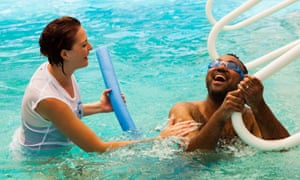
An encounter with a pool noodle. Photograph: Maggie West for the Guardian
Finally, I found Emily Cohen, an instructor who operates a school called the Water Whisperer
out of a pool in Sherman Oaks, an affluent community in the San
Fernando Valley. The name alone sounded comforting, presumably because
it reminded me of the Robert Redford film The Horse Whisperer, which
always seems to put me to sleep whenever it’s on cable. The Water
Whisperer website claimed a 95% success rate and explicitly mentioned
their ability to train adults to overcome their aquatic phobia. Plus, it
was about 20 minutes from my house. •••
The morning of my first lesson, I meet Cohen at her pool. She’s open
and non-threatening like a kindergarten teacher, but also possesses the
kind of stern, paternal qualities that make you not want to disappoint
her. She describes her method as “developmental. It’s layered, and it’s
structured. Little kids feel safe when they know what’s coming next.
There’s also original songs, puppets”. The only thing more frightening
than drowning is puppets, but I was assured there would be none during
my lesson.
She asks me why I don’t swim. I mention my fear, and that because so
many black people don’t swim, it’s made it easier for me to avoid
learning. She’s not surprised. In fact, she says the majority of adults
who come to her are African American. “They say they had a bad
experience or the family didn’t have money. If they came from urban
areas like New York City, it just wasn’t a big thing or their parents
couldn’t afford lessons.”
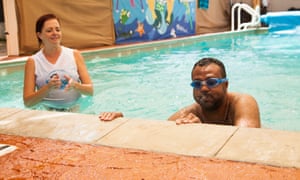
On the edge. Photograph: Maggie West for the Guardian
After stripping down to my freshly purchased trunks, I carefully walk
around the pool slowly, so as not to fall and sink. I begin my
exercises with Emily’s assistant, Monica, to get me comfortable with
breathing techniques. “When you go down, try to keep your eyes open as
long as you can. Go in slowly, and remember, I’m right here if you need
me,” she says reassuringly. I suck in as much air as I can and submerge
my head. I get a solid five seconds in and bolt back up before I run out
of oxygen, having felt the cold specter of death nipping at my heels.
Periodically during the breathing exercises, Monica puts a hand on my
shoulder and offers words of encouragement. “You’re doing great,” she
says. “You’re a natural.” Here I am, a 31-year-old breathing prodigy.
Who knew I had this talent inside of me?
Cohen describes the three steps of overcoming fear of water as
“giving a high five, being brave and doing it anyway”. The fourth should
be “receiving appeals to one’s vanity”, because that always works on
me. “You are literally the best swimmer I have ever seen,” they should
say. “Is that Dave Schilling in the pool or Kevin Costner from
Waterworld?” I’d never stop swimming.
The floating exercises rock my confidence. Monica can’t seem to get
me to flatten out my body enough to practice kicking. “It looks like I’m
not flat because of how big my butt is,” I say. Fortunately, they laugh
rather than asking me nicely to get out of the pool and walk home. That
should be another urban myth about why black people don’t swim. Their
asses are just too big. I have an ass for boxing people out in
basketball, not for swimming.
I’m assured that it’s not my ass that’s keeping me from floating.
It’s my fear. I’m too tense and not allowing the physics to sort
themselves out. I’m sinking because I expect to sink or something like
that. It’s my bloody death wish that’s keeping me from floating!
A 31-year-old prodigy. Photograph: Maggie West for the Guardian
Then, the stern-parent thing with Emily kicks in and I decide I don’t
want to let her down. On my next attempt, I breathe more slowly. I calm
down enough to prevent my fear of the water swallowing me up from
taking over, and it occurs to me that I’ve probably been overthinking
this my entire life. I’ve been so worried about how I look without a
shirt on, whether or not my skin is too black or too thick, and what
other people think of me, that I couldn’t just engage with the task at
hand. Swimming is not an intellectual exercise. It’s visceral, and
bringing heavy thoughts into the pool with me isn’t helping.
Finally, I float. Not for long, but I get there. I earn a few
high-fives, which I relish. Our last exercise is swimming to the wall.
Monica will hold my hands while I kick my way to salvation, then I’ll do
it by myself, but with her hand on my back so that I know someone’s
around to save me if I get overwhelmed.
witterPinterest
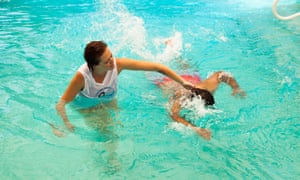
I swam, sort of. Photograph: Maggie West for the Guardian
We move on to swimming the length of the pool. I get to be about 6ft
away from the wall before I run out of breath and swallow a big gulp of
pool water. I’d practiced breathing out of my mouth and my nose while
underwater, but I had tried to do both at the same time and foolishly
opened my mouth a bit too much. I don’t panic. I don’t wail or cry or
moan. I just go back to it. I know that there’s someone there to help me
through it.
I’m winded, but I successfully complete the unassisted laps, though
you can hardly call what I did a proper lap. I swam, sort of – just
enough to retain my dignity. Emily and Monica tell me how great I did.
Only nine more classes to go.
I ask how much a further course of study would cost, and it’s not
cheap. But if I ever want to feel fully a part of my new extended
family, I’m going to have to do it.
Success. Photograph: Maggie West for the Guardian
For many children in nearby neighborhoods like Watts or Compton, the
idea of paying for swimming lessons is something akin to a fantasy – a
rite of passage for other people, not you. You’ll be told that it’s your
fault, your body’s fault for being too black to float. It’s not your
hair or your bones. It’s something far more insidious. It’s a system to
make you feel inferior – economically and emotionally.
After my lesson, I realized that I never learned to swim because I
didn’t think I deserved to. The fear of not being good enough
overpowered my fear of drowning. What’s the point of moping about for
the rest of my life as though I can’t do something? I should be grateful
that I have the time and the resources to even do this, when so many
people don’t. When I came home, my wife asked me if I learned how to
swim. “Not yet,” I told her. “But at least I’m trying,” which is a good
start.
A lack of access to pools and the money to pay for lessons drives a
racial divide in swimming ability. But after getting married, I had no
choice but to dive in
Swimming: why risk it?
Photograph: Maggie West for the Guardian
“If
you just relax, you’ll float. Everyone floats,” Monica, the instructor,
says calmly while I’m flapping my extremities in sheer terror. I’m in
the deep end of a Los Angeles swimming pool in May, and I’m here to
learn how to swim. Swimming
is not something I do, nor am I particularly fond of being in the water
unless I’m in a bubble bath. Why? Drowning. Choking. Sinking to the
bottom. I just can’t figure out why anyone would willfully put
themselves in a situation where they could die so easily. Why risk it? I
also feel this way about skydiving, rock climbing, and unprotected
sexual relations with a stranger in a truck stop bathroom. But here I am
today, decidedly taking this step – or splash, if you will afford me
the rhetorical indulgence.
Throughout my life, curious folks have often asked about my aversion to swimming, and the conversation has inevitably turned to race.
My wife’s aunt came up to me at a family event and said that she heard
“black people’s skin was heavier, therefore they couldn’t float as
easily”. I’m not one to stir up trouble in a social situation. I hate
squabbles, especially when relatives are involved, and there’s no way to
win an argument like that. What was I supposed to do – weigh my own
skin to prove her wrong? All I could do was shrug my shoulders and say,
“Maybe.”
Pinterest
At the pool. Photograph: Maggie West for the Guardian
In truth, black people not swimming is something of a public health problem. A study
by the US Centers for Disease Control and Prevention found that 10
people die every day from drowning. Black and Hispanic youths are far
more likely to drown than white kids. Seventy percent of black children
cannot swim, while only 42% of white children reported a lack of
swimming ability.
The reason for this has nothing to do with physical differences and
everything to do with lack of access. In America, swimming is not a
skill we’re required to learn. It’s a privilege afforded to the
fortunate souls who live near a pool or accessible natural body of
water, and who can afford to pay for lessons. This excludes inner city
African Americans who lack one or both of those opportunities.
I was fortunate to live in a small town in rural central California,
in a middle-class military family that could afford swimming lessons.
Still, I was about as unconventional as one could be in a very
conservative part of the state. My Caucasian father was in the air force
and my African American mother stayed at home to take care of the kids.
In an effort to get me out of the house and away from the Star Trek
reruns that consumed most of my time, she tried to expose me to all
manner of extracurricular activities: tap dancing, racquetball,
jazzercise, and, eventually, swimming. I rejected every single hobby,
but especially swimming. I didn’t see the point. I didn’t like the
water, and as a result I was a dodgy swimmer. I preferred spending my
time on something I had a preternatural knack for: staying indoors.
As I got older, not swimming fit into a comfortable cultural
narrative: the black guy who can’t float. The stereotype became
something of a crutch that propped me up, but also made me dependent.
Then I married into a southern California family. They all swim and
most of them surf, which is so far beyond my ability to comprehend that
they might as well tell me they can bend spoons with their minds or
communicate with dolphins. When we went on our honeymoon in Hawaii, my
wife was concerned I’d have nothing to do; her childhood vacations
consisted of bouncing from one body of water to another.
In freshly purchased trunks. Photograph: Maggie West for the Guardian
I knew from the day we married that I was going to have to learn, at
least so I could understand why my in-laws felt compelled to spend so
much of their free time in the ocean. In the process, I thought I might
better grasp what it is that keeps so many people like myself from
acquiring this skill. So, on a swelteringly hot day, I drove up to the
San Fernando Valley for my first swimming lesson.
There’s no shortage of swimming teachers in Los Angeles. It’s a bit
like working as a nanny, a personal trainer, a nutritionist, or an agent
– you’re a gatekeeper for an important aspect of living in this place.
Aqua Buddies refers to itself as “LA’s primer [sic] mobile swimming
school” and provides “Parent & Me, Toddler Water Safety, and swim
techniques for all the swim strokes”. They’ll drive to your home
swimming pool, like a Postmates or Instacart for vital life skills, I guess.
As one might expect, most of these classes are for children under the
age of 15, so finding a course of study that wouldn’t include me
wearing floaties or singing songs about water safety was difficult. The
Los Angeles YMCA offered adult classes, but I was worried about being
intimidated in a large public gymnasium.
An encounter with a pool noodle. Photograph: Maggie West for the Guardian
Finally, I found Emily Cohen, an instructor who operates a school called the Water Whisperer
out of a pool in Sherman Oaks, an affluent community in the San
Fernando Valley. The name alone sounded comforting, presumably because
it reminded me of the Robert Redford film The Horse Whisperer, which
always seems to put me to sleep whenever it’s on cable. The Water
Whisperer website claimed a 95% success rate and explicitly mentioned
their ability to train adults to overcome their aquatic phobia. Plus, it
was about 20 minutes from my house. •••
The morning of my first lesson, I meet Cohen at her pool. She’s open
and non-threatening like a kindergarten teacher, but also possesses the
kind of stern, paternal qualities that make you not want to disappoint
her. She describes her method as “developmental. It’s layered, and it’s
structured. Little kids feel safe when they know what’s coming next.
There’s also original songs, puppets”. The only thing more frightening
than drowning is puppets, but I was assured there would be none during
my lesson.
She asks me why I don’t swim. I mention my fear, and that because so
many black people don’t swim, it’s made it easier for me to avoid
learning. She’s not surprised. In fact, she says the majority of adults
who come to her are African American. “They say they had a bad
experience or the family didn’t have money. If they came from urban
areas like New York City, it just wasn’t a big thing or their parents
couldn’t afford lessons.”
On the edge. Photograph: Maggie West for the Guardian
After stripping down to my freshly purchased trunks, I carefully walk
around the pool slowly, so as not to fall and sink. I begin my
exercises with Emily’s assistant, Monica, to get me comfortable with
breathing techniques. “When you go down, try to keep your eyes open as
long as you can. Go in slowly, and remember, I’m right here if you need
me,” she says reassuringly. I suck in as much air as I can and submerge
my head. I get a solid five seconds in and bolt back up before I run out
of oxygen, having felt the cold specter of death nipping at my heels.
Periodically during the breathing exercises, Monica puts a hand on my
shoulder and offers words of encouragement. “You’re doing great,” she
says. “You’re a natural.” Here I am, a 31-year-old breathing prodigy.
Who knew I had this talent inside of me?
Cohen describes the three steps of overcoming fear of water as
“giving a high five, being brave and doing it anyway”. The fourth should
be “receiving appeals to one’s vanity”, because that always works on
me. “You are literally the best swimmer I have ever seen,” they should
say. “Is that Dave Schilling in the pool or Kevin Costner from
Waterworld?” I’d never stop swimming.
The floating exercises rock my confidence. Monica can’t seem to get
me to flatten out my body enough to practice kicking. “It looks like I’m
not flat because of how big my butt is,” I say. Fortunately, they laugh
rather than asking me nicely to get out of the pool and walk home. That
should be another urban myth about why black people don’t swim. Their
asses are just too big. I have an ass for boxing people out in
basketball, not for swimming.
I’m assured that it’s not my ass that’s keeping me from floating.
It’s my fear. I’m too tense and not allowing the physics to sort
themselves out. I’m sinking because I expect to sink or something like
that. It’s my bloody death wish that’s keeping me from floating!
A 31-year-old prodigy. Photograph: Maggie West for the Guardian
Then, the stern-parent thing with Emily kicks in and I decide I don’t
want to let her down. On my next attempt, I breathe more slowly. I calm
down enough to prevent my fear of the water swallowing me up from
taking over, and it occurs to me that I’ve probably been overthinking
this my entire life. I’ve been so worried about how I look without a
shirt on, whether or not my skin is too black or too thick, and what
other people think of me, that I couldn’t just engage with the task at
hand. Swimming is not an intellectual exercise. It’s visceral, and
bringing heavy thoughts into the pool with me isn’t helping.
Finally, I float. Not for long, but I get there. I earn a few
high-fives, which I relish. Our last exercise is swimming to the wall.
Monica will hold my hands while I kick my way to salvation, then I’ll do
it by myself, but with her hand on my back so that I know someone’s
around to save me if I get overwhelmed.
witterPinterest
I swam, sort of. Photograph: Maggie West for the Guardian
We move on to swimming the length of the pool. I get to be about 6ft
away from the wall before I run out of breath and swallow a big gulp of
pool water. I’d practiced breathing out of my mouth and my nose while
underwater, but I had tried to do both at the same time and foolishly
opened my mouth a bit too much. I don’t panic. I don’t wail or cry or
moan. I just go back to it. I know that there’s someone there to help me
through it.
I’m winded, but I successfully complete the unassisted laps, though
you can hardly call what I did a proper lap. I swam, sort of – just
enough to retain my dignity. Emily and Monica tell me how great I did.
Only nine more classes to go.
I ask how much a further course of study would cost, and it’s not
cheap. But if I ever want to feel fully a part of my new extended
family, I’m going to have to do it.
Success. Photograph: Maggie West for the Guardian
For many children in nearby neighborhoods like Watts or Compton, the
idea of paying for swimming lessons is something akin to a fantasy – a
rite of passage for other people, not you. You’ll be told that it’s your
fault, your body’s fault for being too black to float. It’s not your
hair or your bones. It’s something far more insidious. It’s a system to
make you feel inferior – economically and emotionally.
After my lesson, I realized that I never learned to swim because I
didn’t think I deserved to. The fear of not being good enough
overpowered my fear of drowning. What’s the point of moping about for
the rest of my life as though I can’t do something? I should be grateful
that I have the time and the resources to even do this, when so many
people don’t. When I came home, my wife asked me if I learned how to
swim. “Not yet,” I told her. “But at least I’m trying,” which is a good
start.
The black guy who can't float: why I finally (almost) learned to swi
Nike’s Wimbledon ‘nightie’ – the most impractical sportswear ever?
Players have criticised the £75 dress for being too revealing, and
getting in the way of their shots. It’s not the first time style has
trumped practicality at the All-England Club
Katie Swan struggles with Nike’s Premier Slam dress on her Wimbledon debut.
Photograph: Shaun Botterill/Getty Images
Phoebe Luckhurst
Underwear scandals are common in SW19. Last year, it was the Canadian Eugenie Bouchard’s black bra strap; in 2014, retired men’s champion Pat Cash denounced pre-match underwear checks. And this year, it is Czech player Lucie Šafářová’s Nike tennis dress, which ballooned all game to expose her knickers.
Few things unite Wimbledon
crowds (sorry, Andy) like a perceived slight against the tournament’s
strictures. But, more to the point: why did Nike design such an
impractical dress for the female players it sponsors?
This was, in fact, the second iteration of the £75 Premier Slam dress: Nike asked players to return it for alterations last week.
Serena Williams and Sabine Lisicki have both reportedly refused to wear
it. “I tried it on but didn’t feel comfortable showing that much,”
Lisicki said. Poor 17-year old Katie Swan struggled with the dress
during her defeat to Tímea Babos yesterday afternoon. Midway through,
she tucked it into her shorts.
“Nike probably has departments devoted to wearer trials,” says Sally
Dixon, the founder of activewear brand Every Second Counts. “I’m very
surprised.” She is sympathetic to Swan’s frustrated mid-match
alteration. “Players don’t expect to have to redesign kit to make it fit
for purpose.”
Notoriously, Wimbledon’s code is the most difficult on the grand slam
circuit. Intimidating guidelines demand competitors “be dressed in
suitable tennis attire that is almost entirely white” as soon as they
“enter the court surround”. They are reminded that “white does not
include off-white or cream”. In 2013, Roger Federer was scolded because
his shoes had orange soles. Moreover, women must negotiate the dynamic
between style, propriety and functionality: brands, keen to appeal to
female consumers chasing the athleisure trend, are most interested in
the first. And it is virtually mandated that women playing at the elite
level wear (very) small skirts – although at least they permit movement.
In the 1920s, the French champion Suzanne Lenglen wore a ballooning
midiskirt to play at Wimbledon. Admittedly, she also drank Cognac on
court.
The obsession with outfits is surely a backhanded sexualisation of the women’s game. From Athena’s Tennis Girl poster
to celebrated but undecorated pin-up Anna Kournikova, girls in tennis
whites are fetishised, their bellowing grunts the subject of flip
sexism. When commentators clocked Simona Halep’s breast reduction
surgery, the British player Laura Robson was furious. ”You see what she
can do with the ball,” she said at the time. “I don’t see how you can bring in boobs to the conversation.”
Anyway, Nike’s “nightie” clearly won’t do. What should tennis kit
look like? “Fitted, for an increased range of movement,” suggests Dixon.
“It should be second skin. What you wear should be the last thing on
your mind.” Never so at Wimbledon.
Abuja High Court sacks
Ali Modu Sheriff as PDP chairman
Oluwatobi Bolashodun 1 hour ago 31655
Share on Facebook
Share on Twitter
Send email
– An Abuja High court has sacked Ali Modu Sheriff as PDP’s national
chairman
– The court nullified the 2014 PDP constitution amendment upon which
Sheriff was appointed as the PDP chairman
– Ali Modu Sheriff-led faction is presently conducting the party’s
governorship primaries in Benin City for the Edo state governorship
election
The embattled national chairman of the Peoples Democratic Party (PDP),
Ali Modu Sheriff has been removed by an Abuja high court on Wednesday,
June 29.
Share on Facebook
Share on Twitter
nazari
Ali Modu Sheriff
The court presided over by Justice Valentine Ashi (court 29), sacked the
party’s chairman from office by nullifying the 2014 PDP constitution
amendment upon which Sheriff was appointed as the PDP chairman.
Senator Ali Modu Sheriff-led faction is presently conducting a
governorship primaries in Benin City for the Edo state governorship
election.
READ ALSO: Modu Sheriff arrives Edo for fresh PDP guber primaries
Sheriff, a former governor of Borno state, was appointed as PDP’s
national chairman in the interim by the party’s stakeholders after
former deputy national chairman, Chief Uche Secondus from the South-East
was removed from the position of acting chairman based on the zoning
arrangement.
The 2014 amendment had purportedly zoned the office of the party
chairman to the North-East zone.
Read more: https://www.naij.com/876283-breaking-fct-high-court-sacks-senator-ali-modu-sheriff-pdp-chairman.html
Abuja High Court sacks
Ali Modu Sheriff as PDP chairman
Oluwatobi Bolashodun 1 hour ago 31655
Share on Facebook
Share on Twitter
Send email
– An Abuja High court has sacked Ali Modu Sheriff as PDP’s national
chairman
– The court nullified the 2014 PDP constitution amendment upon which
Sheriff was appointed as the PDP chairman
– Ali Modu Sheriff-led faction is presently conducting the party’s
governorship primaries in Benin City for the Edo state governorship
election
The embattled national chairman of the Peoples Democratic Party (PDP),
Ali Modu Sheriff has been removed by an Abuja high court on Wednesday,
June 29.
Share on Facebook
Share on Twitter
nazari
Ali Modu Sheriff
The court presided over by Justice Valentine Ashi (court 29), sacked the
party’s chairman from office by nullifying the 2014 PDP constitution
amendment upon which Sheriff was appointed as the PDP chairman.
Senator Ali Modu Sheriff-led faction is presently conducting a
governorship primaries in Benin City for the Edo state governorship
election.
READ ALSO: Modu Sheriff arrives Edo for fresh PDP guber primaries
Sheriff, a former governor of Borno state, was appointed as PDP’s
national chairman in the interim by the party’s stakeholders after
former deputy national chairman, Chief Uche Secondus from the South-East
was removed from the position of acting chairman based on the zoning
arrangement.
The 2014 amendment had purportedly zoned the office of the party
chairman to the North-East zone.
Read more: https://www.naij.com/876283-breaking-fct-high-court-sacks-senator-ali-modu-sheriff-pdp-chairman.html
Nike’s Wimbledon ‘nightie’ – the most impractical sportswear ever?
Players have criticised the £75 dress for being too revealing, and
getting in the way of their shots. It’s not the first time style has
trumped practicality at the All-England Club
Katie Swan struggles with Nike’s Premier Slam dress on her Wimbledon debut.
Photograph: Shaun Botterill/Getty Images
Phoebe Luckhurst
Underwear scandals are common in SW19. Last year, it was the Canadian Eugenie Bouchard’s black bra strap; in 2014, retired men’s champion Pat Cash denounced pre-match underwear checks. And this year, it is Czech player Lucie Šafářová’s Nike tennis dress, which ballooned all game to expose her knickers.
Few things unite Wimbledon
crowds (sorry, Andy) like a perceived slight against the tournament’s
strictures. But, more to the point: why did Nike design such an
impractical dress for the female players it sponsors?
This was, in fact, the second iteration of the £75 Premier Slam dress: Nike asked players to return it for alterations last week.
Serena Williams and Sabine Lisicki have both reportedly refused to wear
it. “I tried it on but didn’t feel comfortable showing that much,”
Lisicki said. Poor 17-year old Katie Swan struggled with the dress
during her defeat to Tímea Babos yesterday afternoon. Midway through,
she tucked it into her shorts.
“Nike probably has departments devoted to wearer trials,” says Sally
Dixon, the founder of activewear brand Every Second Counts. “I’m very
surprised.” She is sympathetic to Swan’s frustrated mid-match
alteration. “Players don’t expect to have to redesign kit to make it fit
for purpose.”
Notoriously, Wimbledon’s code is the most difficult on the grand slam
circuit. Intimidating guidelines demand competitors “be dressed in
suitable tennis attire that is almost entirely white” as soon as they
“enter the court surround”. They are reminded that “white does not
include off-white or cream”. In 2013, Roger Federer was scolded because
his shoes had orange soles. Moreover, women must negotiate the dynamic
between style, propriety and functionality: brands, keen to appeal to
female consumers chasing the athleisure trend, are most interested in
the first. And it is virtually mandated that women playing at the elite
level wear (very) small skirts – although at least they permit movement.
In the 1920s, the French champion Suzanne Lenglen wore a ballooning
midiskirt to play at Wimbledon. Admittedly, she also drank Cognac on
court.
The obsession with outfits is surely a backhanded sexualisation of the women’s game. From Athena’s Tennis Girl poster
to celebrated but undecorated pin-up Anna Kournikova, girls in tennis
whites are fetishised, their bellowing grunts the subject of flip
sexism. When commentators clocked Simona Halep’s breast reduction
surgery, the British player Laura Robson was furious. ”You see what she
can do with the ball,” she said at the time. “I don’t see how you can bring in boobs to the conversation.”
Anyway, Nike’s “nightie” clearly won’t do. What should tennis kit
look like? “Fitted, for an increased range of movement,” suggests Dixon.
“It should be second skin. What you wear should be the last thing on
your mind.” Never so at Wimbledon.
Abuja High Court sacks
Ali Modu Sheriff as PDP chairman
Oluwatobi Bolashodun 1 hour ago 31655
Share on Facebook
Share on Twitter
Send email
– An Abuja High court has sacked Ali Modu Sheriff as PDP’s national
chairman
– The court nullified the 2014 PDP constitution amendment upon which
Sheriff was appointed as the PDP chairman
– Ali Modu Sheriff-led faction is presently conducting the party’s
governorship primaries in Benin City for the Edo state governorship
election
The embattled national chairman of the Peoples Democratic Party (PDP),
Ali Modu Sheriff has been removed by an Abuja high court on Wednesday,
June 29.
Share on Facebook
Share on Twitter
nazari
Ali Modu Sheriff
The court presided over by Justice Valentine Ashi (court 29), sacked the
party’s chairman from office by nullifying the 2014 PDP constitution
amendment upon which Sheriff was appointed as the PDP chairman.
Senator Ali Modu Sheriff-led faction is presently conducting a
governorship primaries in Benin City for the Edo state governorship
election.
READ ALSO: Modu Sheriff arrives Edo for fresh PDP guber primaries
Sheriff, a former governor of Borno state, was appointed as PDP’s
national chairman in the interim by the party’s stakeholders after
former deputy national chairman, Chief Uche Secondus from the South-East
was removed from the position of acting chairman based on the zoning
arrangement.
The 2014 amendment had purportedly zoned the office of the party
chairman to the North-East zone.
Read more: https://www.naij.com/876283-breaking-fct-high-court-sacks-senator-ali-modu-sheriff-pdp-chairman.html
Abuja High Court sacks
Ali Modu Sheriff as PDP chairman
Oluwatobi Bolashodun 1 hour ago 31655
Share on Facebook
Share on Twitter
Send email
– An Abuja High court has sacked Ali Modu Sheriff as PDP’s national
chairman
– The court nullified the 2014 PDP constitution amendment upon which
Sheriff was appointed as the PDP chairman
– Ali Modu Sheriff-led faction is presently conducting the party’s
governorship primaries in Benin City for the Edo state governorship
election
The embattled national chairman of the Peoples Democratic Party (PDP),
Ali Modu Sheriff has been removed by an Abuja high court on Wednesday,
June 29.
Share on Facebook
Share on Twitter
nazari
Ali Modu Sheriff
The court presided over by Justice Valentine Ashi (court 29), sacked the
party’s chairman from office by nullifying the 2014 PDP constitution
amendment upon which Sheriff was appointed as the PDP chairman.
Senator Ali Modu Sheriff-led faction is presently conducting a
governorship primaries in Benin City for the Edo state governorship
election.
READ ALSO: Modu Sheriff arrives Edo for fresh PDP guber primaries
Sheriff, a former governor of Borno state, was appointed as PDP’s
national chairman in the interim by the party’s stakeholders after
former deputy national chairman, Chief Uche Secondus from the South-East
was removed from the position of acting chairman based on the zoning
arrangement.
The 2014 amendment had purportedly zoned the office of the party
chairman to the North-East zone.
Read more: https://www.naij.com/876283-breaking-fct-high-court-sacks-senator-ali-modu-sheriff-pdp-chairman.html
Nike’s Wimbledon ‘nightie’ – the most impractical sportswear ever?

 Pinterest

 witter Pinterest